Metal wall cladding systems began to appear as early as the 18th century. Since then, the industry has gone through many changes, mainly in the types of materials used and their ability to withstand different environmental conditions.
Corrugated sheets began to cover roofs and walls. They were made from materials such as lead and low-carbon steel, which were relatively easy to process and roll into profiled sheets. Soft lead and zinc roofing systems can still be found on many roofs around the world, particularly in Europe.
Over time, sheets made from relatively simple materials gradually developed into more sophisticated engineered products. By the 1970s, the industry was seeing rapid development in carbon steel alloys and aluminium alloys, which were increasingly being used for roofing and exterior wall cladding over steel structures and fabricated frames.
With aluminium, corrugated profiles such as 18/76 and 55/177 asbestos-style profiles began to appear, alongside aluminium cassette systems manufactured from aluminium approximately 2.0 mm thick.
At the beginning of the 21st century, and particularly over the following 17 years, the cladding market saw increasing use of ACP, Aluminium Composite Panels.
With the addition of fire-retardant materials and the development of advanced coating systems in a wide range of colours and textures, ACP became one of the leading materials used in the building cladding industry.
Today, however, we appear to be entering another period of technological development: the era of Honeycomb panels.
These are durable, cost-effective and high-quality panels that, in my opinion, are likely to become an increasingly important product in the cladding market for several reasons:
- The outer skin can be made from different materials, ranging from aluminium to Corten steel treated with salts and acids.
- Honeycomb panels can be manufactured in significantly larger single-panel dimensions than ACP.
- They can provide strong resistance to dead loads and wind loads compared with many alternative systems.
- They do not contain a plastic or polymer core, avoiding some of the issues associated with ACP panels.
- The increasing number of manufacturing plants, particularly in Asia, is helping reduce production and purchasing costs, making Honeycomb panels increasingly competitive compared with ACP.
- Leading architects abroad and in Israel have already begun using the material, and its integration into more buildings is likely to increase over time.
Honeycomb Core Structure
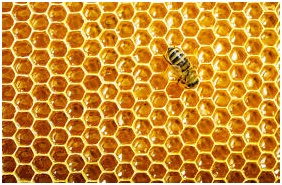
The panel core consists of a lattice made up of thousands of individual cells, most commonly hexagonal in shape.
The name Honeycomb comes from the natural structure of a beehive.
Bees use the same hexagonal form because it provides an extremely efficient way to maximise internal cell volume while using a minimal amount of material for the walls and wax surfaces.
In a natural hive, these cells are used for laying eggs, storing honey and holding other substances required by the colony.
In engineered Honeycomb panels, the same structural principle contributes to strength while also supporting the thermal and acoustic performance of the panel.
The aerospace industry recognised long ago that honeycomb structures could provide an excellent combination of high strength and low weight. Aircraft floors and many other critical aircraft components continue to use this construction method today.
Correct panel design depends on several important parameters, including:
- Hexagonal cell size
- Core wall thickness
- Structural depth of the core
- Thickness of the external skin
- Thickness of the internal skin
By selecting these parameters correctly, it is possible to design a strong, durable panel that is appropriate for the intended application.
Over the years, Honeycomb panels have been adopted in many industries where a lightweight material with high strength provides a clear advantage.
They quickly became common in the automotive industry, particularly in heavy vehicles such as trucks, as well as in marine applications and other specialised sectors.
Bonding Between the Core and Outer Skins
For Honeycomb panels to be suitable for building cladding and roofing, manufacturers had to develop bonding systems capable of achieving high adhesion between the core and the skins covering both sides of the panel.
Interestingly, bees solved a similar problem naturally by creating wax membranes that form both the floor and ceiling of the honeycomb cells.
Increasing aircraft speeds, marine applications and the construction of taller buildings required engineers and technologists to develop products with high resistance to wind, water and air pressure.
A significant part of the structural performance of these panels depends on the quality of the bond between their layers.
Panel Toppings and Finishes
Today, the international market offers a wide variety of Honeycomb panels made from different alloys and materials.
The panels differ not only in their technical specifications but also in their external finishes, or toppings.
Dozens of different finishing systems are currently available.
Natural finishes include:
- Natural wood veneers
- Bamboo
- Natural aggregates
- Natural stone
- Egyptian stone
- Coloured sand
Engineered and metallic finishes include:
- Polyester coatings
- PVDF
- PVF2
- Anodised aluminium
- Zinc
- Titanium
- Copper
- Stainless steel
- PVC flooring finishes
- Patterned sheet metal
- Other anti-slip metal finishes
Load Resistance
As noted above, the size and shape of the cells, material thickness, alloy type and outer sheet properties are among the main factors determining the forces and loads the panel can withstand.
Bond strength is particularly important when concealed fixing systems are used, especially in wall cladding and roofing applications.
Acoustic Performance
By changing the thickness of the materials used in the system, it is possible to reduce a relatively wide range of resonance noise across different frequencies.
In general, the thicker the metal sheets within the panel system, the greater the reduction in sound transmission.
This can improve the panel’s performance in reducing sound intensity measured in dB.
Thermal Insulation
Honeycomb panels can provide a degree of thermal insulation because of the air trapped within the cellular core.
At the same time, the overall system may also conduct heat and cold depending on the materials used.
For this reason, heat transfer and heat distribution must be considered when selecting a panel and designing the system for a particular application.
What Is Currently Available in Israel?
1. Engineering and Design
The L. Efraim office, together with Engineer Arnon Kfir, the author of this article, provides engineering and shop drawing services for projects designed using this innovative material.
The service and technical support are available to both designers and contractors working in the cladding industry generally and with Honeycomb panels specifically.
2. Materials
There is currently a wide range of Honeycomb products available from manufacturers around the world, particularly from Asian markets.
However, these products vary considerably in quality and should be carefully evaluated before being imported for use in Israel.
3. Manufacturing in Israel
A limited number of Israeli companies have already prepared themselves to process and manufacture these systems.
One example is Alum-Gag Ltd., which has established a dedicated production line for Honeycomb panels.
To the best of my knowledge, the production line includes a CNC machine with several dedicated cutting tools, along with a folding machine used for forming the panel edges.
This folding process is particularly important.
Other companies working in this field include Aluminium Construction Ltd., among others.
It is important to emphasise that processing Honeycomb panels requires prior knowledge and experience.
The correct cutting equipment, grooving tools and sequence of operations must be used to minimise the introduction of structural stresses into the panels during fabrication.
Following the correct production process and sequence helps achieve a better finished result on the building facade.
This becomes even more important when working with particularly large-format panels.
Conclusion
What can we expect to see in the future with Honeycomb panels?
In my opinion, the use of panels with thicknesses ranging from approximately 10 mm to 30 mm will continue to grow in the Israeli market, particularly for exterior wall cladding.
The strength of these panels allows designers to create cladding panels in dimensions that were previously uncommon.
Cladding modules are likely to become larger, while CNC machinery will make it possible to create unusual geometric forms such as:
- Triangles
- Hexagons
- Octagons
- Large custom-shaped facade elements
These elements can provide stronger architectural expression across building facades.
The wide variety of available toppings, including advanced coating systems, natural aggregates, titanium, copper and Corten steel, will also provide architects with greater design freedom and allow them to create larger facade elements using new materials and visual effects.
Another important advantage is the improved flatness of large Honeycomb panels.
This may reduce the number of buildings with visibly distorted, concave or warped facades, a problem that has unfortunately appeared on a number of buildings over the past two decades.
More distinctive materials such as Corten steel, titanium, smooth stainless steel and textured stainless steel are also likely to play an increasingly important role in advanced construction.
Potential applications include:
- Residential buildings and towers, particularly balcony areas
- Urban renewal projects
- TAMA 38 projects
- Green construction
- Balcony additions as part of existing building rehabilitation
- Industrial buildings
- Logistics centres
- Desalination facilities
- Chemical plants
- Buildings located in highly corrosive environments classified as C5 and C5M
The continued development of this technology, especially when considered during the early design stages, is expected to create growing demand for professionals, manufacturing plants and consultants who understand these systems and have adapted their facilities accordingly.
I expect to see more manufacturers modernising their production capabilities, similar to companies such as Alum-Gag Ltd. and Aluminium Construction.
It is also reasonable to expect that additional professionals in the fields of design, fabrication and installation will enter this sector, allowing the Israeli market to gradually develop the capacity needed to meet future demand.
Written by Engineer Arnon Kfir, January 2018