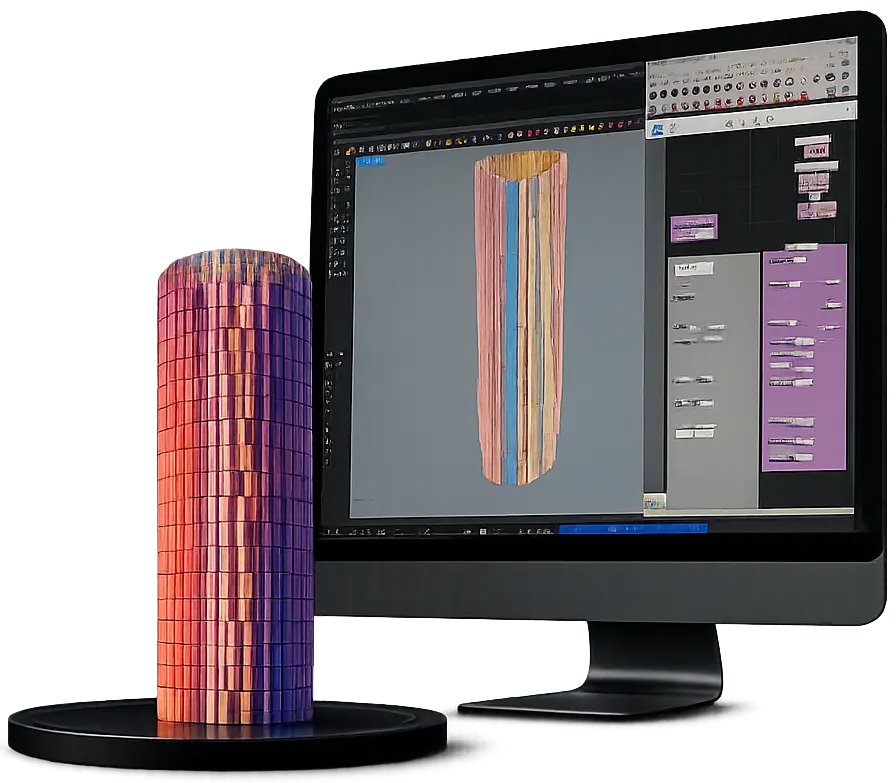
For projects with complex or repetitive geometry, we use parametric modelling and computational workflows to rationalise façade systems, improve geometric control, and efficiently manage large numbers of variable components. These tools support our façade engineering process and help translate complex architectural geometry into practical fabrication documentation.
Architectural geometry and project requirements are analysed to establish the façade system, interfaces, constraints and engineering approach required for detailed development.
Parametric Model
Parametric and computational workflows are used where appropriate to control complex façade geometry, improve consistency and efficiently manage repetitive or variable components.
Rationalization
Complex façade geometries are rationalized into controlled panel and component families while preserving the architectural intent and supporting practical fabrication and assembly.
Fabrication Documentation
Detailed production drawings, dimensional information, material data and assembly documentation are prepared to support accurate fabrication of façade components.
What it means
Complex Geometry Translated Into Practical Fabrication Documentation.
Parametric design is one of the advanced tools we use when a façade involves complex, repetitive or highly variable geometry. It allows us to analyse geometric relationships, manage variations efficiently and maintain consistency throughout the detailed design process. Where appropriate, our computational workflows help identify families of similar components and rationalise complex geometries into a controlled set of practical fabrication types, while respecting the architectural design intent. The result is a more efficient engineering process and clear, coordinated fabrication documentation that supports the production and assembly of complex façade components.
When It Applies
Is your project a candidate?
Parametric design can add significant value when a façade includes complex geometry, a large number of variable components, repetitive elements with changing dimensions, or conditions that require systematic geometric control.
Typical applications may include:
Complex or free-form façade geometry
Large numbers of similar components with dimensional variations
Repetitive panel systems requiring controlled variation
Façades requiring geometric rationalization
Projects where automation can improve consistency and reduce repetitive manual work
Not every project requires a parametric workflow. We use these tools where they provide a clear engineering advantage as part of the overall façade design process.